Have you ever cracked your knuckles and heard someone say, “Stop doing that—you’ll get arthritis”? Let’s find out what science actually says about this common belief (does cracking your knuckles cause arthritis).
Have you ever cracked your knuckles and immediately heard someone say, “Stop doing that—you’ll get arthritis”?
It is one of those warnings that many of us have heard from parents, grandparents, teachers, or friends. The cracking sound can certainly seem alarming, so it is easy to understand why people might think something inside the joint is being damaged.
But does cracking your knuckles actually cause arthritis?
The short answer: No.
Current scientific evidence has not found habitual knuckle cracking to be a significant risk factor for hand osteoarthritis.
So where does that strange popping sound come from? And is knuckle cracking completely harmless?
Let’s separate the myth from the scientific facts.
The Myth: Cracking Your Knuckles Causes Arthritis
The common belief is:
“If you keep cracking your fingers, you will develop arthritis when you get older.”
The idea sounds reasonable at first. After all, repeatedly pulling and bending a joint might seem as though it would gradually wear the joint down.
However, studies comparing people who regularly crack their knuckles with people who do not have generally failed to find a higher rate of hand osteoarthritis among knuckle crackers.
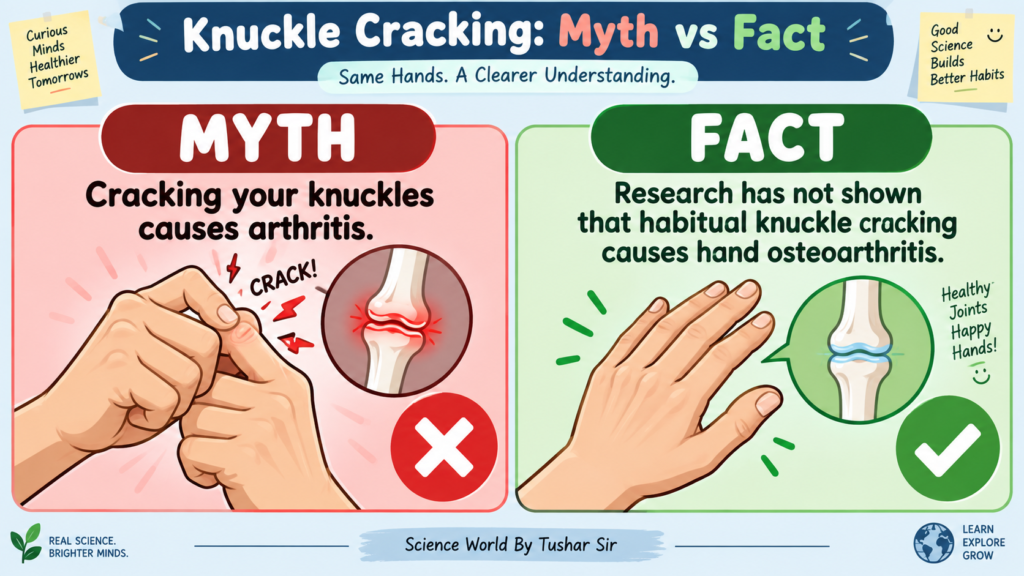
MYTH
Cracking your knuckles causes arthritis.
FACT
Research has not demonstrated that habitual knuckle cracking causes hand osteoarthritis.
What Actually Happens When You Crack a Knuckle?
To understand the cracking sound, we first need to understand the structure of a joint.
The joints in your fingers are known as synovial joints.
Inside these joints is a slippery liquid called synovial fluid.
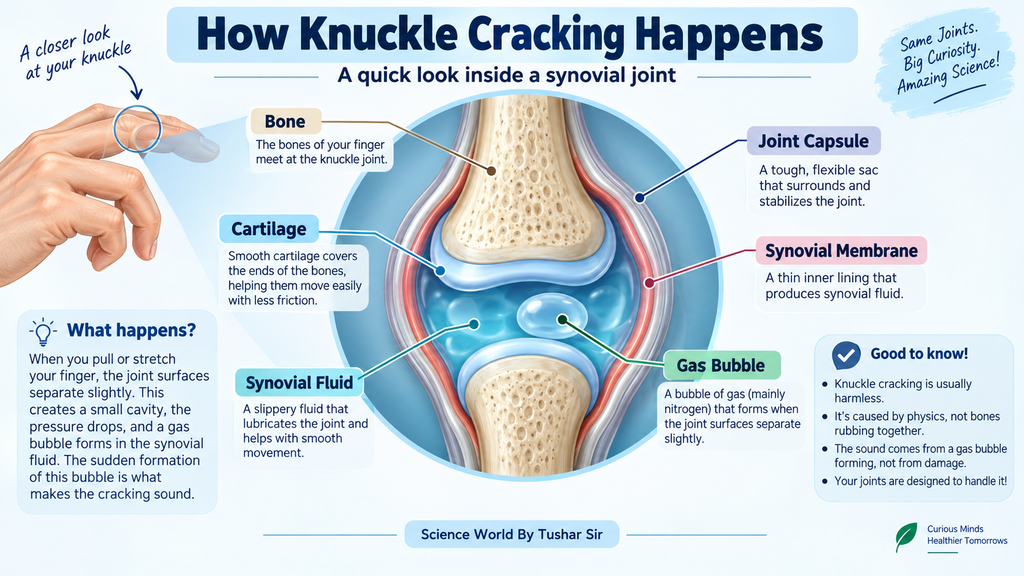
Synovial fluid helps:
- lubricate the joint,
- reduce friction between moving surfaces,
- allow smoother movement,
- and support normal joint function.
Gases are also dissolved within this fluid.
When you pull, stretch, or bend your finger in a certain way, the space between the joint surfaces increases rapidly.
This causes the pressure inside the joint to fall.
A gas-filled cavity or bubble can then form within the synovial fluid—a process associated with cavitation.
That sudden change inside the joint produces the familiar:
POP!
Scientific research agrees that gas-bubble formation is involved, although researchers have debated the precise physical event responsible for the sound itself.
Are Your Bones Cracking?
No.
Despite the name “knuckle cracking,” your bones are not actually cracking or breaking.
The sound comes from changes occurring inside the joint.
So when you hear that loud pop, it does not normally mean that two bones have broken, cracked, or become damaged.
This is one of the biggest misconceptions surrounding knuckle cracking.
Why Can’t You Crack the Same Knuckle Again Immediately?
Try cracking one of your knuckles.
Now try doing it again immediately.
Usually, nothing happens.
Why?
After the joint has been cracked, it takes some time before the conditions inside the joint allow another similar crack to occur.
That is why you generally cannot produce the same popping sound repeatedly every few seconds from the same joint.
What Does Scientific Research Say?
One frequently cited study published in the Journal of the American Board of Family Medicine investigated the relationship between habitual knuckle cracking and hand osteoarthritis.
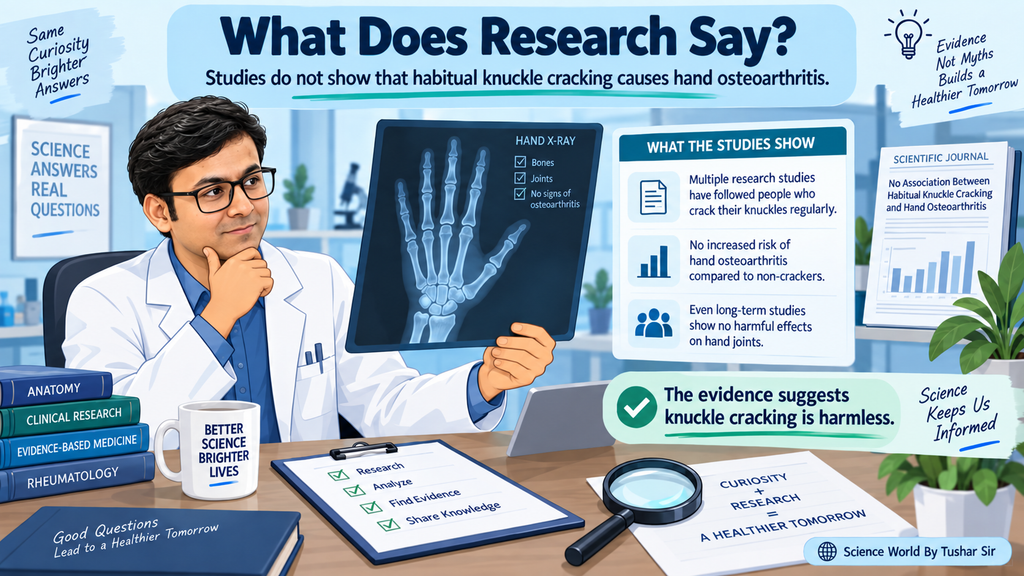
Researchers studied adults between 50 and 89 years of age and examined whether the frequency and duration of knuckle cracking were associated with osteoarthritis.
The researchers found that the prevalence of osteoarthritis was similar among people who cracked their knuckles and those who did not.
They concluded that a history of habitual knuckle cracking—including long-term cumulative exposure—did not appear to be a risk factor for hand osteoarthritis.
A later review of scientific literature reached a similar overall conclusion: observational studies have generally failed to show an association between knuckle cracking and osteoarthritis.
Why Do So Many People Believe the Myth?
There are several possible reasons.
1. The sound seems dangerous
A loud popping sound coming from your body naturally sounds as though something might be breaking.
But sound alone does not mean tissue damage is occurring.
2. Arthritis commonly affects fingers
Arthritis often affects the hands and fingers, especially as people become older.
Because many people also crack their knuckles, it is easy to assume that one caused the other.
But two things happening in the same person do not automatically mean that one caused the other.
3. The warning is passed from generation to generation
Many health myths survive because people hear them repeatedly throughout childhood.
Eventually, they begin to sound like established facts even when scientific evidence does not support them.
What Is Arthritis?
The word arthritis does not describe just one disease.
It refers broadly to conditions involving inflammation, pain, stiffness, or structural changes affecting joints.
One common type is osteoarthritis.
Osteoarthritis involves changes in the tissues of a joint and becomes more common with increasing age.
Other types of arthritis have very different causes.
For example, rheumatoid arthritis is an autoimmune disease in which the immune system mistakenly attacks tissues around joints.
Therefore, saying that ordinary knuckle cracking simply “creates arthritis” greatly oversimplifies what arthritis actually is.
Is Knuckle Cracking Completely Harmless?
For most people, occasional painless knuckle cracking appears unlikely to cause serious harm.
Harvard Health notes that available research has not shown that knuckle cracking raises the risk of arthritis.
However, that does not mean you should force a joint to crack aggressively.
An older observational study involving 300 people found no higher prevalence of hand arthritis among habitual knuckle crackers, although habitual crackers were more likely to have hand swelling and lower grip strength.
Because this type of study shows an association rather than proving cause and effect, it should not be interpreted as proof that cracking itself caused those differences.
Rare injuries have also been reported when people used excessive force while attempting to crack joints.
The sensible rule is simple:
Never force a joint beyond its comfortable range of motion.
When Should Joint Cracking Be Checked?
A painless pop from a knuckle is usually very different from joint noises accompanied by other symptoms.
You should consider speaking with a qualified healthcare professional if joint cracking is accompanied by:
- persistent pain,
- noticeable swelling,
- redness or warmth,
- numbness,
- reduced movement,
- weakness,
- joint instability,
- or a cracking sound that started following an injury.
Painful or swollen joints should not simply be assumed to be harmless “knuckle cracking.”
Harvard Health similarly advises seeking medical attention when joint noises occur along with pain or other concerning joint symptoms.
Knuckle Cracking: Myth vs Fact
| Statement | Myth or Fact? |
|---|---|
| Cracking your knuckles causes arthritis. | Myth |
| Bones are breaking when your knuckles crack. | Myth |
| Changes involving gas inside synovial joints contribute to the popping sound. | Fact |
| Scientific studies have failed to show habitual knuckle cracking causes hand osteoarthritis. | Fact |
| You should force a painful joint until it cracks. | Myth |
| Pain or swelling associated with joint cracking should be evaluated. | Fact |
Frequently Asked Questions
1. Does cracking your knuckles cause arthritis?
Current scientific evidence does not show that habitual knuckle cracking causes hand osteoarthritis.
2. What makes the popping sound when you crack your fingers?
Rapid changes in pressure and gas-containing cavities within the synovial fluid of the joint are involved in producing the characteristic cracking sound.
3. Are my bones rubbing together when I crack my knuckles?
Normally, no. The familiar painless cracking sound is associated with events inside the synovial joint rather than the bones breaking.
4. Is it bad to crack your knuckles every day?
Research has not established habitual knuckle cracking as a cause of osteoarthritis. However, forceful cracking should be avoided, particularly if it causes pain or discomfort.
5. Why does cracking my knuckles sometimes feel good?
Stretching a joint can temporarily create a sensation of release or increased mobility. Some people also develop knuckle cracking as a habit when they are bored, nervous, or trying to relieve tension.
6. Should I worry if my joints crack naturally?
Joint noises without pain are common and are often not a cause for concern. However, cracking accompanied by pain, swelling, instability, numbness, or injury deserves medical attention.
Final Verdict: Myth or Fact?
MYTH: Cracking your knuckles causes arthritis.
The best available evidence does not support the claim that habitual knuckle cracking causes hand osteoarthritis.
The characteristic popping sound is related to rapid physical changes within the fluid-filled joint—not your bones breaking.
So the next time someone tells you:
“Stop cracking your knuckles—you’ll get arthritis!”
you can explain that this familiar warning is a popular myth that has not been supported by current scientific evidence.
However, remember one important distinction:
Painless popping is very different from a painful, swollen, injured, or unstable joint.
If a joint repeatedly hurts or swells, consult a qualified healthcare professional rather than repeatedly trying to crack it.
Science World Takeaway
Myth: Knuckle cracking causes arthritis.
Fact: Scientific studies have not shown habitual knuckle cracking to be a cause of hand osteoarthritis.
Understanding the science behind everyday beliefs helps us separate facts from myths.
Keep questioning. Keep exploring. Keep learning with Science World By Tushar Sir.
References
- Deweber K, Olszewski M, Ortolano R. Knuckle cracking and hand osteoarthritis. Journal of the American Board of Family Medicine, 2011.
- Boutin RD et al. Review of the clinical anatomy and scientific literature surrounding knuckle cracking, 2018.
- Harvard Health Publishing. Does cracking knuckles cause arthritis?
- Harvard Health Publishing. Knuckle cracking: Annoying and harmful, or just annoying?
Medical Disclaimer
This article is intended for general science education and informational purposes only. It is not a substitute for professional medical advice, diagnosis, or treatment. Anyone experiencing persistent joint pain, swelling, stiffness, weakness, numbness, or injury should consult a qualified healthcare professional.
📚 Explore More Everyday Science
Enjoyed learning the science behind knuckle cracking?
Discover more surprising explanations of the things you see and experience every day in our The Science Behind Everyday Things eBook series.
The Science Behind Everyday Things – Volume 1
Discover the fascinating science hidden in ordinary things around us.
The Science Behind Everyday Things – Volume 2
Continue your journey through everyday questions with easy-to-understand scientific explanations.
The Science Behind Everyday Things – Volume 3
Explore more surprising phenomena and understand the science behind how and why they happen.
The Science Behind Everyday Things – Volume 4
Take your curiosity further with another collection of fascinating everyday science explained simply.
For books on similar topics, You can visit our website: www.scienceworldbytusharsir.com