
Imagine stepping through a doorway near Earth and emerging somewhere thousands—or even millions—of light-years away.
Science-fiction movies often show such shortcuts as portals: mysterious gateways connecting distant places almost instantly.
But could anything like this actually exist?
Modern physics has a concept that sounds surprisingly similar: the wormhole.
Wormholes appear in solutions to Einstein’s theory of general relativity, but that does not mean scientists have discovered one or that humans could travel through one.
So, are space portals real science—or just science fiction?
Let’s explore.
What Do We Mean by a Space Portal?
In science fiction, a portal is usually shown as a doorway connecting two distant locations.
Instead of travelling the entire distance between those places, a person simply enters one side and exits through the other.
Physics does not normally use the word portal for this idea.
The closest theoretical concept is called a wormhole.
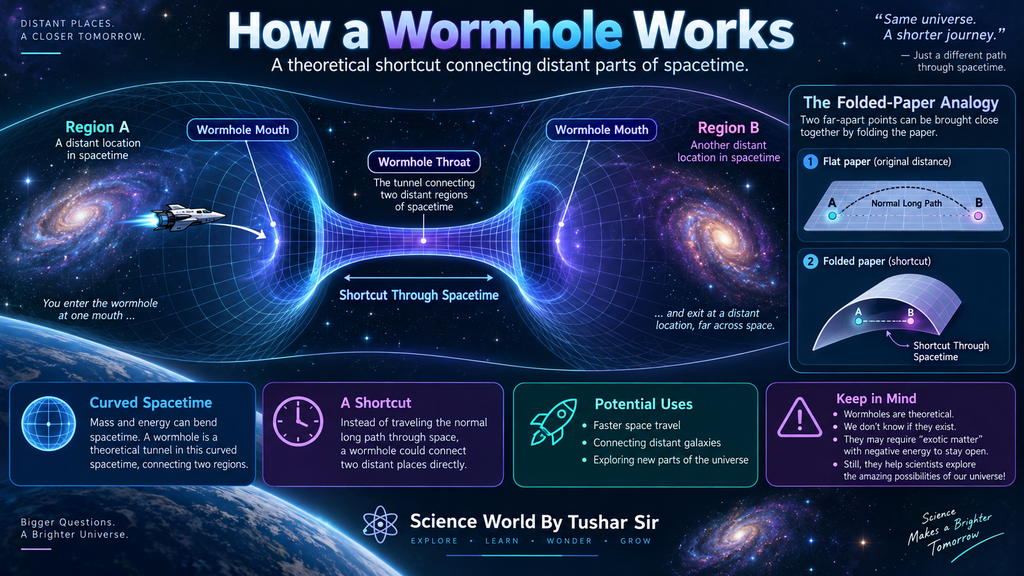
A wormhole would be a shortcut through spacetime, potentially connecting two places that are otherwise extremely far apart.
What Is Spacetime?
To understand wormholes, we first need to understand spacetime.
We usually think about space and time separately.
Space tells us where something is.
Time tells us when something happens.
Einstein’s theory of relativity showed that space and time are closely connected. Together, scientists describe them as spacetime.
Massive objects such as stars, planets and black holes can curve spacetime.
This curvature is what we experience as gravity.
A wormhole would represent an unusual geometry of spacetime where two distant regions become connected by a shortcut.
What Is a Wormhole?
A wormhole can be imagined as a tunnel connecting two different regions of spacetime.
Imagine drawing two dots far apart on a sheet of paper.
Normally, to move from one dot to the other, you would travel across the surface of the paper.
But now fold the paper so the two dots touch.
If you could create a tunnel directly between them, the journey would become much shorter.
This folded-paper example is only an analogy, but it helps illustrate the idea.
A wormhole could potentially create a shorter path between two distant regions of the universe.
Where Did the Idea of Wormholes Come From?
The idea comes from Einstein’s theory of general relativity.
In 1935, Albert Einstein and physicist Nathan Rosen studied a mathematical structure that later became known as an Einstein-Rosen bridge.
The equations suggested a connection between different regions of spacetime.
This idea eventually became associated with what we now commonly call a wormhole.
However, the original Einstein-Rosen bridge would not work as a practical tunnel for spacecraft or humans.
It would close too quickly to allow anything to pass through.
Could Wormholes Connect Distant Parts of the Universe?
In theory, certain wormhole models could connect regions separated by enormous distances.
Imagine Earth and a star system located thousands of light-years away.
Travelling through ordinary space would take an extremely long time.
But if the two regions were connected by a stable wormhole, the path through the wormhole could potentially be much shorter.
This is why wormholes are sometimes described as cosmic shortcuts.
However, this remains theoretical.
No usable wormhole has ever been discovered.
Are Wormholes Real?
This is one of the most important distinctions.
Wormholes are allowed in certain mathematical models.
But:
We have no confirmed observational evidence that traversable wormholes exist in nature.
Physics equations can describe many possible structures, but a mathematical solution does not automatically mean nature actually creates that structure.
Scientists would need observational evidence before wormholes could be considered physically confirmed objects.
At present, none has been found.
What Is a Traversable Wormhole?
A traversable wormhole is a hypothetical wormhole that an object could safely enter, travel through and exit.
For that to happen, the wormhole would need to remain open long enough.
That creates a major problem.
Gravity tends to make many theoretical wormhole structures unstable.
Instead of remaining open like a tunnel, the wormhole could collapse before anything could cross it.
Physicists have therefore explored whether unusual forms of matter or energy might hold a wormhole open.
What Is Exotic Matter?
Some theoretical models of traversable wormholes require something often called exotic matter.
This does not mean extraterrestrial matter.
In this context, exotic matter refers to matter or energy with unusual properties—such as energy conditions very different from ordinary matter.
Certain quantum effects can produce situations involving negative energy densities under special circumstances.
However, scientists do not currently know how to create or maintain the enormous conditions that a macroscopic traversable wormhole might require.
So exotic matter remains one of the biggest problems for practical wormhole travel.
Wormhole vs Black Hole: Are They the Same?
No.
Black holes and wormholes are not the same thing.
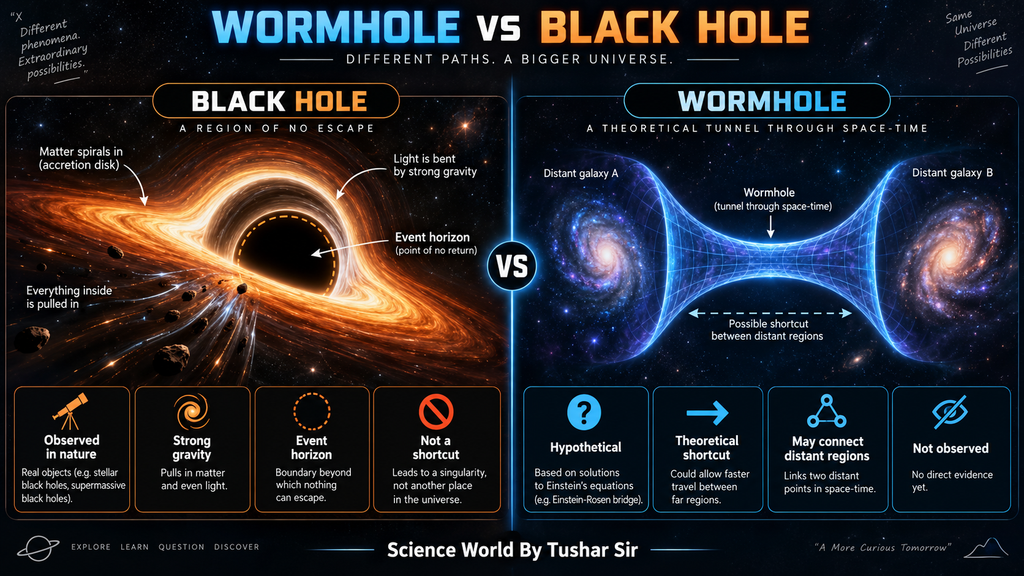
A black hole is a region where gravity is so strong that, beyond a boundary called the event horizon, nothing can return to the outside.
Black holes have strong observational support. Astronomers have detected their effects, observed stars orbiting them and even produced images of the environments around supermassive black holes.
A wormhole, on the other hand, is a hypothetical connection between different regions of spacetime.
No traversable wormhole has been observed.
| Feature | Black Hole | Wormhole |
|---|---|---|
| Supported by observations | Yes | Not yet |
| Predicted by relativity | Yes | Certain solutions allow them |
| Has an event horizon | Typically yes | Depends on the model |
| Connects distant locations | Not in the usual black-hole description | Possibly, theoretically |
| Human travel possible | Extremely dangerous | Unknown and hypothetical |
Could a Black Hole Be a Wormhole Entrance?
Science fiction often shows black holes as gateways.
Real physics is much more complicated.
The event horizon of a black hole is not known to function as a safe doorway.
Once an object falls sufficiently far into an ordinary black hole, extreme gravity and spacetime curvature make escape impossible according to current understanding.
Some mathematical models connect black-hole-like regions to other parts of spacetime, but this does not mean real astronomical black holes are practical wormhole entrances.
Could Wormholes Connect Different Universes?
Some theoretical models raise the possibility that wormholes could connect not only distant regions within one universe but perhaps separate regions sometimes interpreted as different universes.
However, this idea is highly speculative.
We do not currently have evidence that other universes exist, nor do we have evidence of wormholes connecting them.
So this remains an interesting theoretical possibility rather than an established scientific fact.
Could Humans Travel Through a Wormhole?
At present, we simply do not know.
A usable wormhole would need to solve several enormous problems:
- It would need to exist.
- It would need to be large enough.
- It would need to remain stable.
- Tidal gravitational forces would need to be survivable.
- Radiation levels would need to be safe.
- Its entrance and exit would need to be accessible.
- It might require forms of energy that we cannot currently control.
Because of these difficulties, wormhole travel is far beyond present technology.
Could Wormholes Allow Faster-Than-Light Travel?
This question needs careful explanation.
A traveller passing through a wormhole might appear to reach a distant destination much faster than light travelling through ordinary space between the same locations.
But locally, the traveller would not necessarily need to move faster than light.
Instead, the wormhole would provide a shorter route through spacetime.
An analogy is taking a tunnel through a mountain instead of travelling all the way around it.
You are not moving faster—you are travelling a shorter path.
Could Wormholes Be Used for Time Travel?
Some theoretical wormhole models raise another extraordinary possibility: time travel.
If the two mouths of a wormhole experienced time differently—for example because one travelled at very high speed or experienced a different gravitational environment—the passage might theoretically link different times as well as different locations.
This creates serious problems involving causality.
For example, it could lead to paradoxes where an event changes its own past.
Physicists still debate how nature might prevent such situations.
There is currently no experimental evidence that wormholes can be used as time machines.
Why Would Wormholes Collapse?
Gravity is one of the biggest challenges.
A wormhole throat would have to remain open.
Without some mechanism to stabilize it, gravitational effects could cause the passage to pinch shut.
Some theoretical models suggest negative energy might counteract this collapse.
But maintaining enough negative energy over a large region is far beyond anything demonstrated experimentally.
Therefore, even if microscopic wormhole-like structures were theoretically possible, making one large and stable enough for humans would be another matter entirely.
Have Scientists Ever Found a Wormhole?
No confirmed wormhole has been detected.
Astronomers have occasionally studied whether strange gravitational signals or unusual objects might mimic features expected from hypothetical wormholes.
But so far, there is no accepted observational evidence proving that a wormhole exists.
This distinction is important:
Wormholes are scientifically studied theoretical possibilities, not discovered cosmic highways.
Could Tiny Wormholes Exist?
Some ideas in quantum gravity suggest that spacetime at extremely tiny scales may not be perfectly smooth.
Physicist John Wheeler famously proposed the idea of quantum foam, in which spacetime could fluctuate dramatically at incredibly small scales.
Some speculative theories imagine microscopic wormhole-like connections appearing within this quantum structure.
However, a complete experimentally confirmed theory of quantum gravity does not yet exist.
So microscopic wormholes remain speculative as well.
Wormholes in Movies vs Real Science
Movies often show portals as glowing circles that open instantly and safely transport people to another world.
Real theoretical wormholes would probably be far stranger.
Science fiction often assumes:
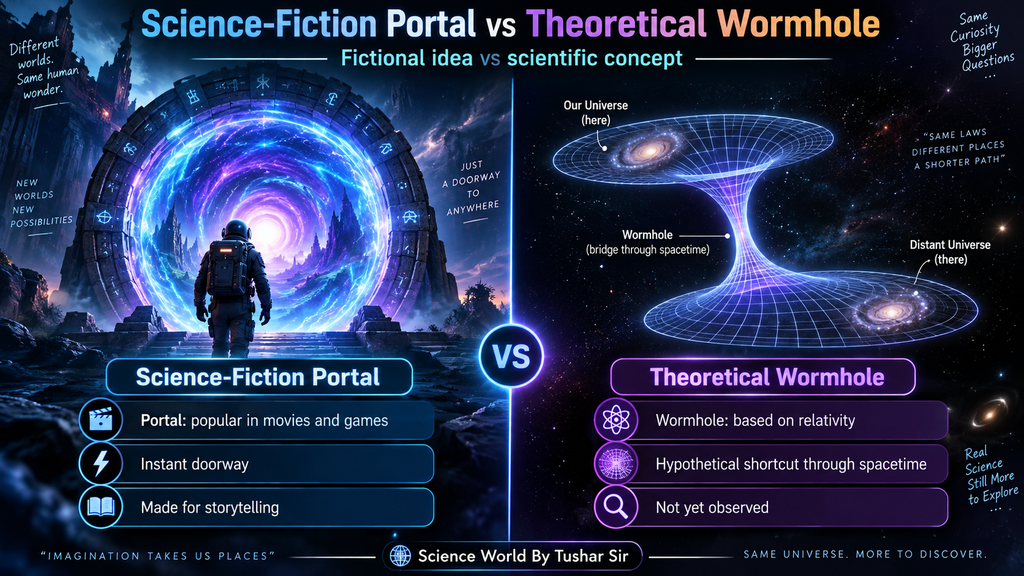
Portal opens → person walks through → arrives safely.
Real physics would require answers to much harder questions.
How would the wormhole stay open?
How much energy would it require?
Would gravitational forces destroy the traveller?
Would radiation make passage impossible?
Could the entrance even remain stable?
Would causality problems appear?
These unanswered questions are why wormholes remain one of the most fascinating boundaries between physics and science fiction.
What Would a Wormhole Look Like?
A wormhole probably would not look like a simple circular doorway floating in space.
If one existed, light from the region on the other side could be strongly distorted by gravity.
The entrance might therefore show unusual gravitational-lensing effects.
It could appear somewhat like a distorted window into another region of space.
Exactly what it looked like would depend on the structure of the wormhole and the surrounding gravitational field.
Why Do Scientists Study Wormholes If We Have Never Seen One?
Because theoretical physics often explores what the laws of nature permit.
Studying wormholes helps researchers investigate important questions about:
gravity,
spacetime,
black holes,
quantum physics,
causality,
and the fundamental structure of the universe.
Even if traversable wormholes turn out not to exist, studying them can still reveal important information about the limits of physical theories.
Myth vs Fact
| Statement | Answer |
|---|---|
| Scientists have discovered space portals | No |
| Wormholes appear in theoretical physics | Yes |
| Wormholes have been directly observed | No |
| A wormhole could theoretically connect distant regions | In some models |
| Humans can currently travel through wormholes | No |
| Wormholes and black holes are exactly the same | No |
| Some wormhole models raise the possibility of time travel | Theoretically |
| Wormhole travel is proven technology | No |
Frequently Asked Questions
Are wormholes real?
Wormholes are legitimate objects studied in theoretical physics, but no traversable wormhole has ever been confirmed observationally.
Has NASA discovered a portal in space?
There is currently no accepted scientific evidence that NASA or another space agency has discovered a traversable portal or wormhole that can transport matter between distant locations.
Can humans make a wormhole?
There is currently no known technology capable of creating a macroscopic, stable wormhole.
Could a wormhole take us to another galaxy?
In some theoretical models, a wormhole could connect extremely distant locations, potentially including regions in different galaxies. But this has never been demonstrated.
Are black holes portals?
Ordinary black holes are not known to be portals. Some theoretical equations involving black holes resemble wormhole-like structures, but this does not make observed black holes usable gateways.
Could a wormhole allow time travel?
Certain theoretical configurations suggest this possibility, but there is no experimental evidence showing that such a system can actually exist.
Have astronomers seen a wormhole?
No confirmed astronomical observation has identified a wormhole.
Final Science Verdict
So, can portals through space really exist?
Physics does not completely dismiss the idea.
General relativity contains mathematical solutions resembling wormholes, and physicists continue studying whether some form of traversable wormhole could be physically possible.
But there is a huge difference between:
“The equations allow us to discuss it”
and
“We have found one in the universe.”
At present:
No traversable wormhole has been observed.
We do not know whether nature creates them.
We do not know how to build one.
And we certainly do not yet know how to travel safely through one.
For now, space portals remain an extraordinary idea sitting at the border between theoretical physics and science fiction.
Science World Takeaway
A wormhole is a hypothetical shortcut through spacetime that could, in principle, connect widely separated locations.
Einstein’s theory of relativity provides the mathematical framework in which wormhole-like structures can be discussed, but there is currently no observational evidence that traversable wormholes exist.
That is what makes them so fascinating: they are not simply fantasy, but neither are they established cosmic highways.
Keep questioning. Keep exploring. Keep learning with Science World By Tushar Sir.
Suggested Medical/Science Disclaimer
This article is intended for general science education. Wormholes and traversable spacetime shortcuts discussed here are theoretical concepts in modern physics. No traversable wormhole has been experimentally confirmed.