
During a thunderstorm, we often see a bright flash of lightning and hear thunder several seconds later. This delay may make it seem as though lightning occurs before thunder, but both are produced almost simultaneously (Why Is Lightning Seen Before Thunder?).
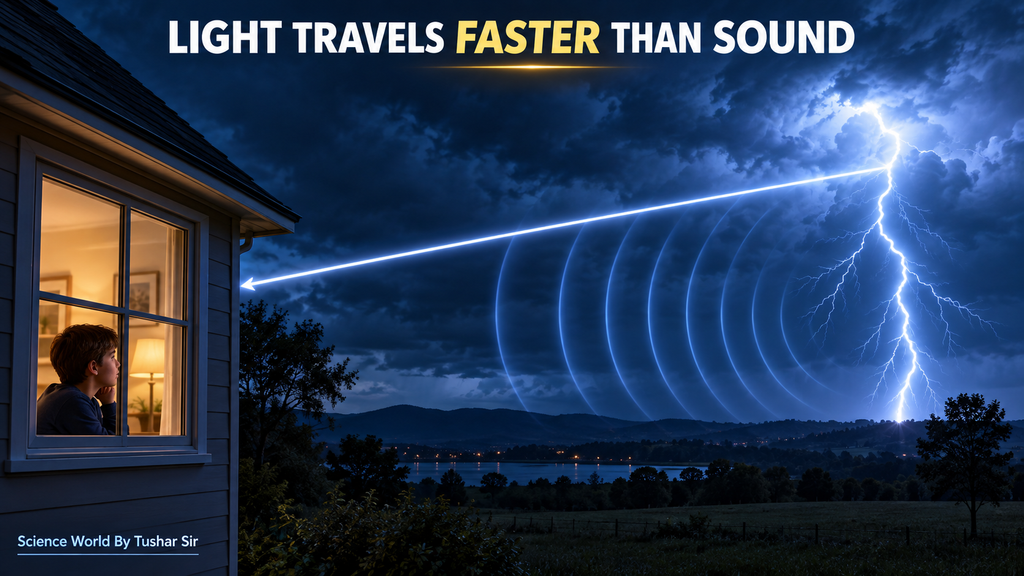
We see lightning first because light travels enormously faster than sound. The difference between their speeds creates the familiar gap between the flash and the rumble.
Table of Contents
Lightning and Thunder Occur Together
Lightning is a powerful electrical discharge that can occur:
- Inside a cloud
- Between two clouds
- Between a cloud and the ground
- Between a cloud and the surrounding air
A lightning discharge rapidly heats the nearby air. The heated air expands suddenly and produces a pressure wave that travels through the atmosphere as sound. We hear this sound as thunder.
Therefore, thunder is produced because of lightning. They do not normally occur as two separate weather events.
The light reaches our eyes almost immediately, while the sound takes longer to travel to our ears.
Light Travels Much Faster Than Sound
The speed of light in a vacuum is approximately:
The speed of sound in air at approximately is about:
Light is therefore hundreds of thousands of times faster than sound in air.
Imagine that lightning strikes three kilometres away. Its light reaches your eyes in only a tiny fraction of a second. However, the sound may require approximately nine seconds to reach you.
This is why you see the flash before hearing the thunder.
Comparing the Speeds of Light and Sound
The difference becomes clearer when we compare the distance travelled in one second.
| Type of wave | Approximate distance travelled in one second |
|---|---|
| Light | 300,000 kilometres |
| Sound in air | 343 metres |
Light could travel around Earth several times in one second. Sound would cover only a small fraction of one kilometre during the same time.
Over the relatively short distances involved in a thunderstorm, the travel time of light is almost impossible for us to notice. The travel time of sound, however, produces a noticeable delay.
How Is Thunder Produced?
A lightning channel can heat the surrounding air to an extremely high temperature within a very short time.
The rapidly heated air expands violently. This sudden expansion compresses the surrounding air and creates a powerful pressure wave.
As the pressure wave travels outward and weakens, it becomes the sound wave that we hear as thunder.
Nearby thunder may sound like:
- A loud crack
- A sharp bang
- An explosive clap
More distant thunder often sounds like a long, low rumble.
Thunder is not produced by clouds colliding. It is produced by the rapid heating and expansion of air around a lightning channel.
How Can We Estimate the Distance of a Thunderstorm?
The delay between lightning and thunder can provide a rough estimate of the storm’s distance.
Flash-to-bang method
- Begin counting seconds as soon as you see a lightning flash.
- Stop counting when you hear thunder.
- Divide the number of seconds by three to estimate the distance in kilometres.
For example:
For an estimate in miles, divide the number of seconds by approximately five.
| Delay | Approximate distance |
|---|---|
| 3 seconds | 1 kilometre |
| 6 seconds | 2 kilometres |
| 9 seconds | 3 kilometres |
| 15 seconds | 5 kilometres |
This is only an approximation because the speed of sound changes slightly with temperature, humidity and atmospheric conditions.
Most importantly, do not use this calculation to decide whether it is safe to remain outdoors. If you can hear thunder, lightning is close enough to present a danger.
Why Does Thunder Sometimes Rumble?
Lightning does not usually occur at one single point. A lightning channel can extend across a considerable distance and may have many branches.
Sound from different parts of that channel travels different distances before reaching you. The sound from the nearest part arrives first, while sound from more distant parts arrives later.
Sound waves can also reflect from:
- Clouds
- Hills
- Mountains
- Buildings
- The ground
These effects spread the sound over several seconds, producing a long rumble rather than one sharp bang.
Temperature differences and wind can also bend sound waves and influence how thunder is heard.
Why Is Nearby Thunder Sharper?
When lightning occurs nearby, the sound has less distance to travel. Many high-frequency sound waves can reach you before being weakened by the atmosphere.
As a result, nearby thunder often sounds like a sudden crack or explosive clap.
Over longer distances, higher-frequency sounds weaken more easily. The lower-frequency components travel farther, making distant thunder sound deeper and softer.
Can We Have Lightning Without Thunder?
Lightning always produces thunder, but we may not always hear it.
Thunder can become too weak to hear when the lightning is far away. Wind, buildings, hills and other sounds may also prevent it from reaching us clearly.
Distant lightning that is visible without audible thunder is sometimes informally called heat lightning. It is not a special type of lightning created by hot weather. It is usually ordinary lightning from a distant thunderstorm whose thunder cannot be heard.
Can Thunder Occur Without Lightning?
Thunder is the sound produced by lightning. Therefore, true thunder does not occur without a lightning discharge.
Other loud sounds—such as explosions, aircraft or construction—may resemble thunder, but they have different causes.
Essential Lightning Safety Rules
Lightning is dangerous. Follow these precautions whenever thunderstorms are nearby:
- Go inside a substantial building or a hard-topped enclosed vehicle.
- Avoid open fields, rooftops, hilltops and isolated tall objects.
- Do not shelter under an isolated tree.
- Stay away from ponds, pools, rivers and other bodies of water.
- Avoid touching plumbing, electrical wiring and corded appliances indoors.
- Stay away from windows and exterior doors.
- Do not lie flat on the ground.
- Wait at least 30 minutes after the last sound of thunder before returning outdoors.
The National Weather Service’s simple safety message is that when thunder is heard, people should move indoors. It also advises remaining inside for at least 30 minutes after the final thunder. National Weather Service lightning safety guidance
Common Myths and Facts
Myth: Lightning never strikes the same place twice
Fact: Lightning can strike the same location repeatedly. Tall structures are especially likely to receive multiple strikes.
Myth: It is safe outside when rain has not started
Fact: Lightning can occur away from the heaviest rain. Hearing thunder is enough reason to seek shelter.
Myth: Rubber shoes completely protect a person
Fact: Ordinary rubber footwear does not provide reliable protection against lightning.
Myth: Crouching outdoors makes a person safe
Fact: No outdoor location is completely safe during a thunderstorm. The correct action is to enter a substantial building or enclosed vehicle.
Myth: Heat lightning is a different kind of lightning
Fact: “Heat lightning” is normally distant lightning whose thunder is too far away to be heard.
Quick Facts
- Lightning and thunder are created almost simultaneously.
- We see lightning first because light travels much faster than sound.
- Light travels at approximately 300,000 kilometres per second in a vacuum.
- Sound travels through air at approximately 343 metres per second near room temperature.
- A delay of roughly three seconds represents about one kilometre.
- Thunder is caused by the rapid heating and expansion of air.
- A long lightning channel can create a prolonged rumble.
- If thunder is audible, move to a safe indoor location.
Conclusion
We see lightning before hearing thunder because light travels far faster than sound.
The flash reaches our eyes almost instantly, but the sound wave created by the rapidly expanding heated air takes longer to reach us. The longer the delay between the flash and thunder, the farther away the lightning was—although hearing any thunder means it is time to seek safe shelter.
This familiar storm experience provides a powerful everyday demonstration of the difference between the speeds of light and sound.
Frequently Asked Questions
Why is lightning seen before thunder is heard?
Light travels much faster than sound. The light reaches our eyes almost immediately, while the sound takes longer to travel through the air.
Do lightning and thunder happen at the same time?
They occur almost simultaneously. Thunder is produced when lightning rapidly heats and expands the surrounding air.
How far away is lightning if thunder arrives after six seconds?
Using the approximate three-seconds-per-kilometre method, the lightning was roughly two kilometres away.
Why does thunder sound like a long rumble?
Sound from different parts of an extended lightning channel reaches the observer at different times. Reflections from clouds, terrain and buildings can extend the rumble.
Is it safe if the storm appears far away?
No outdoor location should be considered safe when thunder is audible. Move into a substantial building or enclosed hard-topped vehicle.
Why can we sometimes see lightning but not hear thunder?
The lightning may be far enough away that its sound weakens before reaching you, or the sound may be blocked or masked by atmospheric conditions and surrounding noise.