
Have you ever looked at the clear daytime sky and wondered Why Is the Sky Blue? Sunlight usually looks white, yet the sky can display brilliant shades of blue during the day and red, orange or pink colours around sunset.
The answer lies in the way sunlight interacts with gases and tiny particles in Earth’s atmosphere. This process is known as scattering of light. Let us explore the science behind one of nature’s most familiar sights.
Table of Contents
Sunlight Is Made of Many Colours
Although sunlight appears white, it is actually a mixture of different colours. These colours form the visible spectrum:
- Violet
- Indigo
- Blue
- Green
- Yellow
- Orange
- Red
A prism can separate white light into these colours, producing a spectrum similar to a rainbow.
Each colour has a different wavelength. Violet and blue light have relatively short wavelengths, while orange and red light have longer wavelengths.
Approximate visible wavelengths include:
| Colour | Approximate wavelength |
|---|---|
| Violet | 380–450 nanometres |
| Blue | 450–495 nanometres |
| Green | 495–570 nanometres |
| Yellow | 570–590 nanometres |
| Orange | 590–620 nanometres |
| Red | 620–750 nanometres |
These wavelength differences determine how strongly each colour is scattered in the atmosphere.
What Happens When Sunlight Enters the Atmosphere?
Earth’s atmosphere contains gases, including nitrogen and oxygen, along with water vapour, dust and other small particles.
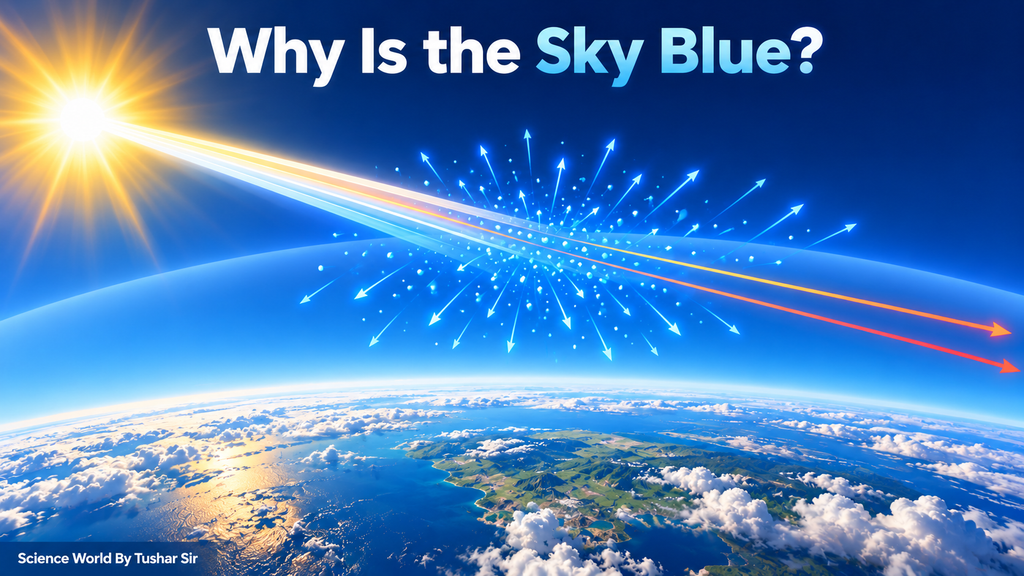
When sunlight enters the atmosphere, it collides with gas molecules. The light is then redirected in many directions instead of travelling only in a straight line.
This redirection is called scattering.
Different wavelengths do not scatter equally. Shorter wavelengths are scattered much more strongly by atmospheric gas molecules than longer wavelengths. Therefore, blue and violet light are spread across the sky more effectively than red and orange light.
When we look in almost any direction during the day, some of this scattered blue light enters our eyes. Consequently, the sky appears blue.
What Is Rayleigh Scattering?
The scattering responsible for most of the blue colour of a clear sky is called Rayleigh scattering. It occurs when light interacts with particles or molecules that are much smaller than the wavelength of the light.
Rayleigh scattering is strongly dependent on wavelength. Its approximate relationship can be expressed as:
Here, represents the wavelength of light.
This relationship means that a small reduction in wavelength produces a large increase in scattering. For example, blue light is scattered far more strongly than red light because blue has a shorter wavelength.
Rayleigh scattering also helps explain why distant mountains sometimes appear bluish and why the Sun changes colour near the horizon.
Why Does the Sky Look Blue Instead of Violet?
Violet light has a shorter wavelength than blue light, so it is scattered even more strongly. This raises an interesting question: why does the sky not appear violet?
There are several reasons:
- Sunlight contains different amounts of each visible wavelength. The sunlight reaching Earth does not provide equal intensity across all visible colours.
- Some violet light is absorbed in the upper atmosphere. This reduces the amount that reaches our eyes.
- Human eyes are more sensitive to blue than violet. The cone cells in our eyes do not respond as strongly to violet light.
- Scattered colours combine in our vision. The mixture of scattered violet, blue and some green light is generally perceived as blue.
For these reasons, the daytime sky usually looks blue rather than violet.
Why Does the Sky Look Pale Near the Horizon?
The sky directly above us often appears deeper blue than the sky near the horizon.
When we look toward the horizon, light must travel through a greater thickness of atmosphere before reaching our eyes. During this longer journey, the light undergoes repeated scattering. Dust, water droplets and other larger particles can also scatter a broader range of colours.
The mixture of these scattered colours makes the horizon appear pale blue, whitish or slightly grey, particularly in humid or polluted conditions.
Why Are Sunrise and Sunset Red?
At sunrise and sunset, the Sun is close to the horizon. Its light must travel through a much longer path in the atmosphere than it does when the Sun is overhead.
During this long journey, much of the shorter-wavelength blue and violet light is scattered away from our direct line of sight. The longer-wavelength red and orange light can travel through the atmosphere more effectively and reach our eyes.
This is why the Sun and the surrounding sky often appear:
- Yellow
- Orange
- Red
- Pink
Dust, smoke, pollution and clouds can influence the intensity and variety of sunset colours. However, excessive atmospheric pollution should not be confused with a naturally beautiful or healthy sunset.
Why Does the Sky Sometimes Look Grey or White?
The sky does not always look blue. Clouds contain water droplets or ice crystals that are much larger than gas molecules.
These larger particles scatter visible wavelengths more evenly through a process broadly associated with Mie scattering. Because many colours are scattered together, clouds commonly appear white.
Thick clouds block and absorb more light. Less light reaches their lower surfaces, causing them to appear dark grey before rain or a storm.
Haze, dust and pollution can also make the sky look pale, grey or white by changing how light is scattered.
Is the Sky Blue Because It Reflects the Ocean?
A common myth claims that the sky appears blue because it reflects the colour of the ocean. This is incorrect.
The sky appears blue primarily because atmospheric molecules scatter shorter wavelengths of sunlight. The sky is also blue over locations far away from oceans, including deserts, forests and inland regions.
In reality, the relationship can work partly in the opposite direction. Large bodies of water can reflect the colour of the sky. Water also absorbs longer red wavelengths more readily than blue wavelengths, especially when viewed through a sufficient depth of clear water.
Therefore, the ocean does not cause the blue colour of the sky.
What Colour Is the Sky on Other Planets?
The colour of a planet’s sky depends on the composition and density of its atmosphere and the particles suspended within it.
Mars, for example, has a thin atmosphere containing large amounts of fine dust. During much of the Martian day, this dust gives the sky a reddish or butterscotch appearance. Near the Sun during sunset, the Martian sky can appear bluish.
The Moon has almost no atmosphere. With no substantial atmosphere to scatter sunlight, its sky appears black even when the Sun is shining.
These examples show that a blue sky is not universal. It is produced by the particular way sunlight interacts with Earth’s atmosphere.
Quick Facts About the Blue Sky
- Sunlight contains all the colours of the visible spectrum.
- Atmospheric gases scatter shorter wavelengths more strongly.
- Rayleigh scattering is the main reason a clear daytime sky appears blue.
- Our eyes are more sensitive to blue light than violet light.
- The sky looks red or orange at sunset because sunlight travels through more atmosphere.
- Clouds appear white because their droplets scatter many visible wavelengths.
- The sky would look black without an atmosphere, even during the day.
- The ocean is not responsible for making the sky blue.
A Simple Observation Activity
You can observe scattering using water and a small amount of milk.
Materials
- A transparent glass or container
- Clean water
- A few drops of milk
- A flashlight
- Adult or teacher supervision
Procedure
- Fill the transparent container with water.
- Add only a few drops of milk and mix gently.
- Shine the flashlight through one side of the container.
- Observe the light from the side.
- Then observe the light coming through the opposite end.
The tiny particles in the diluted milk scatter shorter wavelengths, making the light viewed from the side appear slightly bluish. The transmitted light may appear more yellow, orange or red.
Safety note: Never perform this activity using direct sunlight, lasers or high-powered lamps. Do not look directly into a bright light source.
Conclusion
The sky appears blue because molecules in Earth’s atmosphere scatter the shorter wavelengths of sunlight more strongly than the longer wavelengths. This phenomenon is called Rayleigh scattering.
During the day, scattered blue light reaches our eyes from across the sky. At sunrise and sunset, sunlight travels through more atmosphere, and much of the blue light is scattered away. This allows red and orange wavelengths to dominate.
The next time you look at a blue sky or a colourful sunset, remember that you are observing sunlight interacting with the atmosphere—a beautiful example of science hidden in everyday life.
Frequently Asked Questions
Why is the sky blue in one sentence?
The sky appears blue because atmospheric molecules scatter the shorter blue wavelengths of sunlight more strongly than the longer red wavelengths.
Why is space black?
Space appears black because it lacks a sufficiently dense atmosphere to scatter sunlight across the sky.
Why does the sky turn red at sunset?
Sunlight travels through more atmosphere at sunset. Much of its blue light is scattered away, leaving more red and orange light to reach our eyes directly.
Why are clouds white?
Cloud droplets and ice crystals scatter many visible wavelengths approximately together. Their combined light appears white.
Is violet light scattered more than blue light?
Yes. However, our eyes are less sensitive to violet, some violet light is absorbed in the atmosphere, and the combined scattered light is generally perceived as blue.
Does pollution make sunsets redder?
Smoke, dust and pollution can change the scattering of light and intensify certain colours. However, a colourful sunset is not necessarily evidence of clean or polluted air.